Twelve years ago, pig farmer Edwin Tijs first heard about a vitalizer at a study group meeting. One experiment led to the next, and eventually to the regenerative agriculture course. It didn’t all go smoothly. “After the first year of the course, I didn’t understand a thing.”
Step by step
It started with an evening at a study group. Edwin heard about a vitalizer there, a device that can restore water to its original structure, and began experimenting with it. Next came fermented feed with micro-organisms, first dried and later liquid. There was no plan laid out in advance; one experiment simply led him to the next.
About eight years ago, bokashi came into the picture as well. He now makes around 400 tonnes of it a year, which goes onto the land just before tillage, together with a small amount of slurry.
Only later did the term regenerative agriculture come into view, and Edwin signed up for the course. The first year mostly left him confused: it was so complicated, so much information at once, and on top of that the question of how to actually put it into practice on your own farm. Anyone taking the course for the first time now, he says, will recognise that.
Still, he saw something in it. He took the course again, and the pieces of the puzzle fell into place.
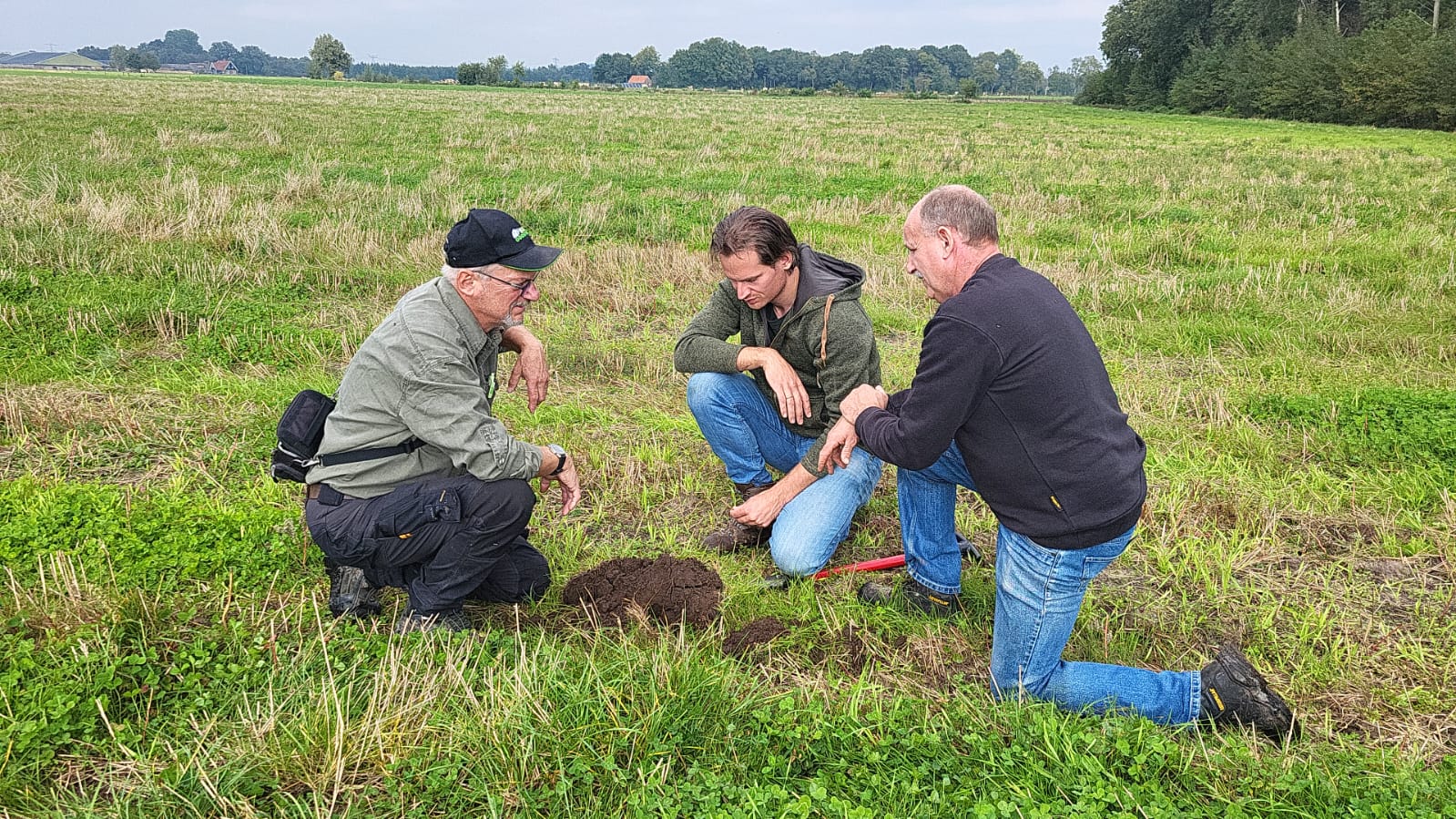
After that came intensive on-farm coaching with Dietmar Näser. What changed most was the way he looked at his fields. What do you see? What does that tell you about the soil? And what do you do with it next? That way of looking has since become an important part of how he farms.
It’s about balance
Edwin doesn’t claim that his crops suddenly started growing better as a result. “I’ve had a failed harvest just like my neighbour. If the harvest is smaller than expected, it’s the same here.” He doesn’t see a difference in his income either; serious investments have been made. For now, the change is in the soil.
In 2022, Edwin had a soil scan done of all his fields and soil samples taken at many locations; those same spots were sampled again in 2024 and 2026. In the first year after the baseline measurement, the soil declined on some points, but now, in 2026, he is seeing recovery. “You see a better balance in the soil and a clear increase in organic matter.”
“You see a better balance in the soil and a clear increase in organic matter.”
For him, it isn’t about pushing any single mineral as high as possible, but about the balance between the elements.
“Soil life doesn’t benefit from sky-high levels of one mineral and very low levels of another. It functions best when the minerals are well balanced.”
He sees the same idea at work in his barns. There too, it doesn’t work to keep pushing up one nutrient; it’s about the balance of the whole.
That’s why he calls the current way of farming ‘crowbar farming’: putting more and more pressure on the soil, the animals or the crop to achieve a certain result, trying to get there by bending and prying against nature. “That always works against you; nature is much stronger than we are.”
Forcing less
The regenerative route isn’t necessarily easier, Edwin says. But it does demand attention to the processes taking place in the soil and to the possibilities already present on the farm. If those start functioning better, the farmer has to force things less, and a crop becomes more resilient to pests, diseases and extreme weather.
Exactly how that works isn’t entirely clear to him yet. “Right now it’s still minimal, and we’re doing a lot of experimenting, gaining knowledge and learning from each other.”
And that is precisely one of the biggest obstacles. Gaining knowledge takes time, and figuring out what actually works on your own farm takes even more. Farms with little financial room don’t always have that option. Subsidies, moreover, don’t always fit the way farmers want to change.
Just start
He himself is carrying on. Next week, another new step is already planned: compost extract. Not because he knows exactly where it will lead, but because he now knows which direction he wants to go. “That’s the right direction, that’s where I want to go: making the soil better. Then the whole farm does better.”
For farmers wondering where to begin, Edwin doesn’t have a complicated step-by-step plan. First, gain knowledge through the course. Learn to look. And then start in small steps.
“Whatever you do, you have to make a start. Then you naturally get caught up in the current.”
Discover regenerative agriculture in practice
Want to get started with regenerative farming too? Explore our courses and learn how to put soil and plant health at the heart of how you run your farm.